


- The ARM Africa Trade Finance Fund
The ARM Africa Trade Finance Fund (AATFF) represents a transformative approach to one of Africa's most persistent economic challenges: the trade finance gap. Structured as a commercially-driven blended finance initiative, AATFF is engineered to generate compelling, risk-adjusted returns while systematically addressing the market failures that constrain the continent's productive capacity.
AATFF operates through two distinct but complementary investment vehicles, each designed to serve specific investor bases while deploying the same innovative product strategy: the FI Trade 3.0 Schema combined with Embedded Option Bond Security architecture.
- Unique Edge
Core Value Proposition
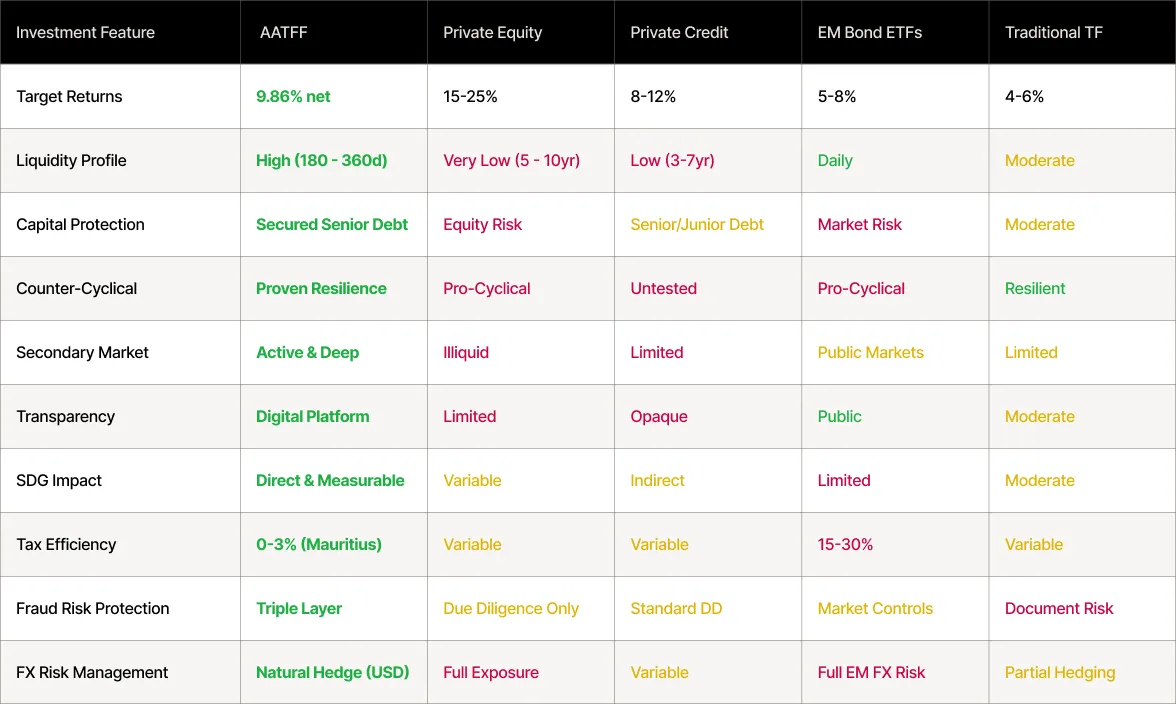
AATFF occupies a unique position in the alternative investments landscape by simultaneously delivering three characteristics that are typically mutually exclusive: institutional-grade liquidity, attractive risk-adjusted returns, and profound developmental impact. This convergence creates what we term the 'AATFF Sweet Spot'—the intersection where performance, alternative asset characteristics, liquidity, and impact investment converge.

Liquidity & Capital Protection
Short-duration (180-360 day) self-liquidating trade finance assets with active secondary market access and triple credit enhancement.

High Yield & Diversification
Target net leveraged returns of 9.86% (USD Fund) and 17.89-18.89% (Naira Fund), with low correlation to public markets.

Counter-Cyclical & Impact
Proven crisis resilience through GFC and COVID-19, with measurable SDG impact via digital platform.

- Core Solutions
Key Pain Points Solved
The African trade finance gap—estimated at $100-130 billion annually—is not a function of credit quality but of structural market failure. AATFF's strategy surgically addresses each root cause:
The Basel Paradox
Global banking regulations (Basel III/IV) have created perverse incentives where African bank treasurers are rationally compelled to hold government bonds rather than lend to SMEs. An estimated $1.4 trillion in government securities sits idle on African bank balance sheets while the real economy starves for credit.
Previous Fund Failures
Historic trade finance fund failures (Barak, Abraaj, Greensill) shared common causes: corporate fraud, concentration risk, and liquidity mismatches. AATFF's design elegantly averts all three through FI intermediation (regulated counterparties), natural diversification (millions of underlying SME transactions), and short-term, self-liquidating assets with deep secondary market access.
Practical ESG Implementation
Well-intentioned DFI initiatives have failed due to unworkable ESG reporting requirements for high-volume, small-ticket transactional banking. AATFF's pragmatic sustainability approach focuses on portfolio-level impact measurement aligned with the UN’s The Sevilla Commitment.
- Integrated Security
Aggregation & Embedded Option Security

FI Trade 3.0 Aggregation Model
Rather than financing individual SME transactions (unscalable) or providing generic wholesale liquidity (ineligible for DFI support), AATFF provides secured portfolio finance facilities to regulated African Financial Institutions who act as 'Aggregators.' These Aggregators then deploy capital to their SME trade portfolios. This model transforms the diffuse, high-cost-to-monitor risk of millions of individual SME invoices into the concentrated, regulated, and stable counterparty risk of established FIs.

Embedded Option Bond Security
This breakthrough financial instrument unlocks the $1.4 trillion in government securities currently trapped on African bank balance sheets. Unlike traditional pledges or repos that trigger regulatory encumbrance (reducing the bank's Liquidity Coverage Ratio), the Embedded Option mechanism uses Call/Put options contingent on default events. Under IFRS and Basel rules, such contingent options do not constitute 'encumbrance' until exercised—allowing banks to maintain their regulatory ratios while effectively providing 150% collateral coverage to AATFF.
- Tiered Reinforcement
Triple Credit Enhancement Architecture
This structure transforms millions of 'risky SME loans' into an institutional-grade asset:
First Way Out (Trade Risk)
Primary repayment from short-term, self-liquidating trade transactions. Historical default rate: <0.2%
Second Way Out (FI Risk)
Direct obligor is a regulated African bank with prudential oversight. FI Trade Finance achieves 0.03% default rate—equivalent to AAA-rated securities
Third Way Out (Sovereign Security)
Ultimate backstop via government bond collateral accessed through an embedded option, with 150% coverage
- Distinctive Edge
Unique Investment Benefits
This structure transforms millions of 'risky SME loans' into an institutional-grade asset:

- Proven Legacy
ARM's 30+ Year Investment Heritage

Asset & Resource Management Holding Company Limited (ARM) is a leading Nigerian-founded financial services group with three decades of on-the-ground operational excellence across Africa. With managed assets historically reaching USD 2.0 billion (prior to the strategic 2024 pension divestment), ARM brings institutional credibility, regulatory relationships, and deep market knowledge to the AATFF platform. The 2024 divestment from pension management represents ARM's strategic pivot to focus on pioneering alternative investment solutions in Africa—of which AATFF is a flagship initiative.

- Investment Strategy
FI Trade 3.0 Innovation
AATFF's strategy represents a paradigm shift in trade finance investment:

From Transaction to Portfolio
Moving beyond transaction-by-transaction refinancing to portfolio-level investment enables scale, diversification, and institutional-grade governance

From LC Orthodoxy to Product Inclusion
Validating 'Open Account' and 'Working Capital' products as investable trade assets, recognizing how SMEs actually use banking products

From Exclusion to Inclusion
Encompassing NBFIs and Fintechs as legitimate aggregators, extending reach to the 'Missing Middle'
- Core Foundations
The Eight Differentiating Pillars
These eight pillars are the core design principles of the Fund, each chosen to address specific market challenges and to work in concert to protect investor capital while maximizing impact and returns.
Pillar 1 – FI Aggregation Approach
The Fund's foundational principle is to provide portfolio finance facilities to local African FIs, NBFIs, and Sovereigns, who act as 'Aggregators.' This is the only practical and scalable methodology to channel institutional capital to the vast, fragmented, and granular African SME trade segment. A direct-to-SME lending model would be operationally unfeasible and prohibitively expensive.
Pillar 2 – Pragmatic Sustainability & Impact
The Fund explicitly rejects the application of conventional investment banking ESG frameworks that are ill-suited to African SME transactional banking. Instead, it adopts a pragmatic approach grounded in transactional banking principles, focusing on the inherent developmental impact of SME trade. This is a critical differentiator designed to avoid the pitfalls of past DFI initiatives where overly burdensome reporting requirements led to the non-disbursement of capital.
Pillar 3 – The Triple Credit Enhancement
This is the heart of the Fund's risk mitigation architecture. It is a three-layered process that systematically de-risks African trade assets: selecting an inherently low-risk asset class (short-term trade finance); transforming the diffuse risk of individual SME invoices into the stable, regulated counterparty risk of established FIs; and transforming this FI risk from an unsecured exposure into a fully secured one through robust collateralization.
Pillar 4 – Innovative Security Architecture
This pillar ensures legal enforceability across diverse African jurisdictions. For banks, the mechanism takes Call/Put options over government bond holdings (150% coverage), preserving LCR ratios while securing the Fund. This utilizes the most liquid collateral in these markets and directly addresses the regulatory pressures that cause the trade finance gap. For NBFIs, a stricter, bespoke security regime is applied, primarily a pledge over USD-denominated international collection accounts.
Pillar 5 – Practical Product Utilization, Market Access & Flexibility
The Fund prioritizes established, practical, and well-understood FI trade finance products with proven market acceptance. The Management Team's deep expertise provides the flexibility to access both the Primary Market (via direct origination) and the Secondary Market in both directions, ensuring optimal risk management and that financing is immediately usable.
Pillar 6 – Judicious Use of Leverage & Strategic Fund Rating
Prudent NAV leverage (targeting 1.5x) is a strategic design choice to amplify returns to a level attractive to institutional investors, complemented by a multi-stage strategy to secure credit ratings to broaden the investor base and enable the capital-efficient Phase 3 guarantee strategy. This leverage is central to the fund's strategic goal of catalyzing private capital, resolving the price discovery paradox of FI trade assets.
Pillar 7 – Catalyzing Impact through SDG 17 Partnerships
Through the Management Team's extensive market relationships, the Fund will facilitate the attachment of Technical Assistance grants, DFI guarantees, and other credit enhancements to its facilities. This helps Aggregators and their SME clients cover costs associated with capacity building, product development and systems upgrades, directly lowering cost barriers to entry.
Pillar 8 – Digitally-Native Operations for Scalability & Transparency
The Fund will be built on a specialist digital trade finance platform, delivering Day-One institutional-grade infrastructure. This ensures massive scalability, enhances risk management through real-time data, and provides unparalleled transparency for investors, allowing for data-backed impact reporting that is both meaningful and operationally efficient.
- Sustainability & Impact
Sustainability & Impact
The Fund explicitly rejects the application of conventional investment banking ESG frameworks that are ill-suited to African SME transactional banking. Instead, it adopts a pragmatic approach grounded in transactional banking principles, focusing on the inherent developmental impact of SME trade. This is a critical differentiator designed to avoid the pitfalls of past DFI initiatives where overly burdensome reporting requirements led to the non-disbursement of capital.
- disclaimer 1
USD Fund (Mauritius)
The ARM Africa Trade Finance Fund (USD) will be structured as an LLC GBC1 licensed as a Collective Investment Scheme (CIS) Fund, domiciled in Mauritius. The Fund will be regulated by the Financial Services Commission (FSC) of Mauritius.
This document does not constitute an offer or solicitation to subscribe for units in the Fund. Subscription for units in the Fund may only be made on the basis of the Fund's Private Placement Memorandum (PPM) and the relevant subscription documents. Prospective investors should carefully consider the investment objectives, risks, charges, and expenses of the Fund before investing. This and other important information wiil be contained in the PPM, which prospective investors should read carefully before investing.
Investment in the Fund involves significant risk. The value of investments and any income derived from them may go down as well as up, and investors may not receive back the amount originally invested. Past performance is not necessarily indicative of future results. The Fund invests in emerging markets, which may involve additional risks including currency risk, political risk, and liquidity risk.
This document contains forward-looking statements regarding the belief or current expectations of the Fund Manager about the Fund's business and the transactions described herein. These forward-looking statements are not guarantees of future performance and involve known and unknown risks, uncertainties, and other factors that may cause actual results to differ materially from those expressed or implied.
- disclaimer 2
Naira Fund (Nigeria)
The ARM Africa Trade Finance Fund (Naira) is structured as an open-ended Unit Trust Scheme registered with the Securities and Exchange Commission (SEC) of Nigeria. The Fund is managed by ARM Investment Managers Limited (ARM IM), an SEC-registered Fund Manager. The Fund is governed by a Trust Deed, with STL Trustees Limited as Trustee and Rand Merchant Bank Nigeria Limited as Custodian.
Units in this Fund are securities in which Pension Fund Assets can be invested, subject to the provisions of the Pension Reform Act and the Regulation on Investment of Pension Fund Assets issued by the National Pension Commission (PENCOM). Pension Fund Administrators (PFAs) should ensure that any investment in this Fund complies with their applicable investment limits under the Multi-Fund Structure.
This document does not constitute an offer or solicitation to subscribe for units in the Fund. Subscription for units may only be made on the basis of the Fund's Prospectus and the relevant subscription documents. Prospective investors should carefully consider the investment objectives, risks, charges, and expenses of the Fund before investing.
Investment in the Fund involves risk, including the possible loss of principal. The Fund invests in trade finance facilities to Nigerian banks, which involves credit risk, concentration risk, and operational risk. Returns are not guaranteed and past performance is not indicative of future results. The Fund's returns are denominated in Nigerian Naira and may be affected by inflation and changes in monetary policy.
- disclaimer 3